
Article translation
Published May 31, 2022
Responsible fashion: “Buy less, but buy better”
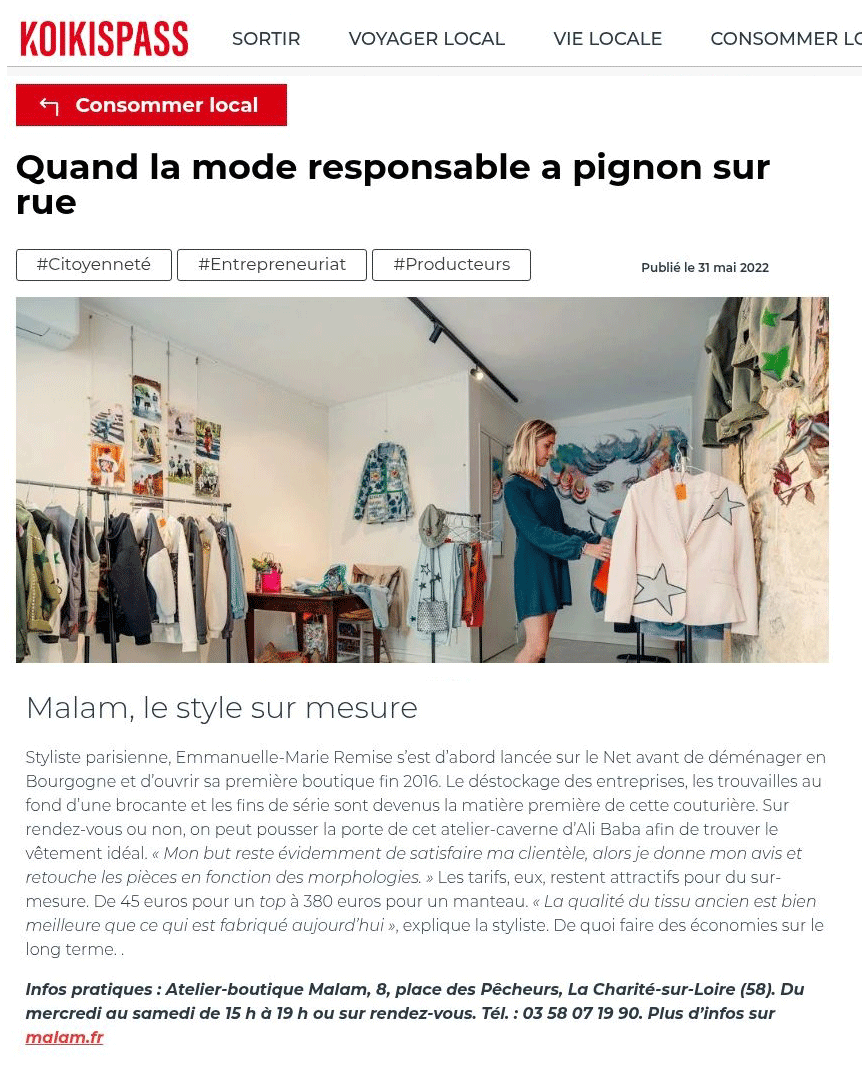
Designer Emmanuelle-Marie Remise opened the Malam boutique in La Charité-sur-Loire and follows a recycling-oriented approach / Photo by Yann Pendaries
Getting dressed is no longer simply a question of style. What impact does the fashion industry have on the planet, and what does responsible fashion really mean? Gildas Minvielle, director of the economic observatory at the Institut Français de la Mode, explains.
How harmful is the fashion industry to the planet?
Gildas Minvielle: We often read that fashion is the second most polluting industry on the planet. I would be more cautious about that claim. There is still enormous progress to be made in the production of materials such as cotton, which uses a great deal of water, as well as certain synthetic fibres. But the issue is more complex. European Commission studies show that, in addition to textile production, services, storage and transport also need to be taken into account. Over roughly the past five years, in response to consumers’ expectations and demands, most companies, from Primark to luxury brands, have been moving towards more responsible fashion.
What triggered this shift?
I think the Rana Plaza tragedy, when the garment factory building collapsed in Dhaka, Bangladesh in 2013, had a profound impact. It also prompted deeper reflection on the social and environmental consequences of globalisation. Working conditions for textile workers need to improve. The issue itself is not new. What is new is how widespread this concern has become.
What would ideal responsible fashion look like to you?
Many criteria come into play. There is a great deal of discussion about recycling, second-hand clothing and where products are made. It is reasonable to think that a product made in France is subject to greater oversight than one produced in a distant region, and that social conditions are better. But I also believe in a circular fashion economy. Despite the technical constraints, recycling would need to become widespread if we are to stop constantly drawing on the planet’s resources.
Is second-hand fashion a solution?
Second-hand is only the lesser of two evils because a product still has a finite lifespan. It merely postpones the problem. Using materials such as recycled polyester seems to me to be part of the future. For now, however, this technique remains too expensive for some consumers. I have little faith in the environmental responsibility of ultra-low-cost retailers. So for the moment, the solution for consumers is still to buy less, but buy better.
How can consumers make sense of it all?
It is difficult to give simple advice when product information is not mandatory. There are legislative proposals for clearer labelling, somewhat like what already exists for food. This would allow consumers to take both the material and the product’s origin into account and make more informed purchases.
You remain very positive...
I work with many companies that are moving towards improvement and progress, driven by increasingly demanding consumers. It is a deep underlying movement, and awareness will continue to grow. We have even seen environmental issues enter political debate more strongly. There is still a great deal of inertia, but younger generations seem eager to make things change. So I remain hopeful.
Read the Institut Français de la Mode study on responsible fashion at ifmparis.fr
Virginie Jannière